My first novel, The Whisper of Falling Snow, will be published on KDP in ePUB, softcover, and hardcover on July 21. Preorders for the ePUB version are available on Amazon.
In a world shaped by ideology and power, memory becomes an act of resistance—and the cost of forgetting is measured in human lives. Is forgiveness possible? Can love endure?
In the late twenty-first century, the Party of Democracy and Social Justice governs the former United States of America, now reconstituted as the United Federated Districts, through surveillance, ideological conformity, and the quiet administration of death. Gregory Stepanov, a senior Party official tasked with overseeing public wellbeing, has spent decades upholding a system he never truly believed in.
As political tensions deepen within the regime, Stepanov and his closest ally, State Security operative Jeffrey Dane, find themselves increasingly trapped between loyalty and conscience, private devotion and public obedience.
When Stepanov signs the involuntary euthanasia order for his former teacher, John Pavlov, he sets loose a series of crises where memory—and love—become impossible to suppress.
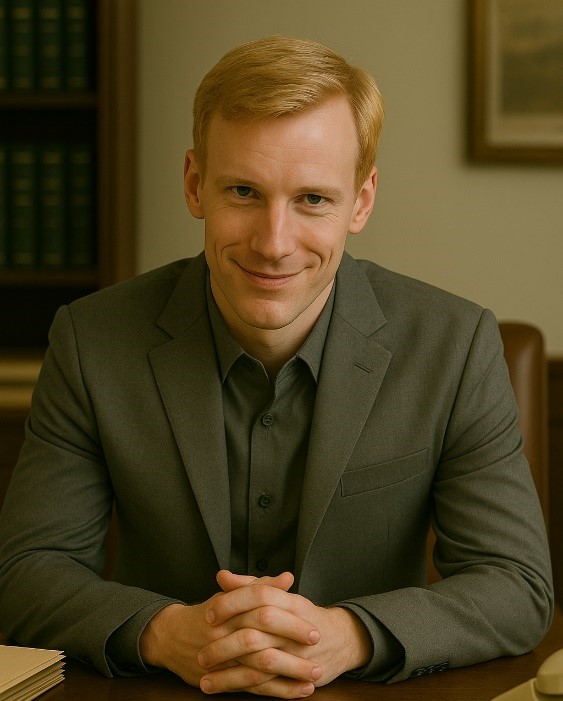
I hold a BA in Soviet and Eastern European Studies and MAs in Theology and History. My background informs the novel’s exploration of authoritarianism, memory, and moral reckoning. I live with my spouse in Clinton, Massachusetts. I am working on the second book in THE WHISPER OF FALLING SNOW series, THE UNSPEAKABLE CITY, which I plan to have out in late 2027
A golden-brown face stared back, its almond-shaped hazel eyes reddened and hollowed from a night of grief and guilt, its normally wavy hair awry. His face, stripped of its beauty.
He wrung his soaped hands under the cold water. A bleak mixture of sleet and snow hissed against the windows.
The language of the Snake.
Gregory Stepanov had had a good man murdered, a man whom he had respected and loved for many years. True, he had extended his life by more than a decade before he signed—had been forced to sign—the recalcitrant old man’s death warrant.
Like Pontius Pilate, “I am guiltless of this man’s death.” Except I’m not, and neither was Pilate.
Stepanov detested the “Sunday Specials,” and there were dozens of them every week. They were strangers, but as he signed their death warrants, Stepanov hated each one of them personally, by name.
By the time they went up the crematory chimney, though, he had forgotten them. Until the next week. And the whole damned process began again. Week after week. Year after year.
Yesterday was different. Yesterday was personal. Yesterday was John Pavlov. No matter how delayed, a betrayal is a betrayal, and Gregory Stepanov knew it
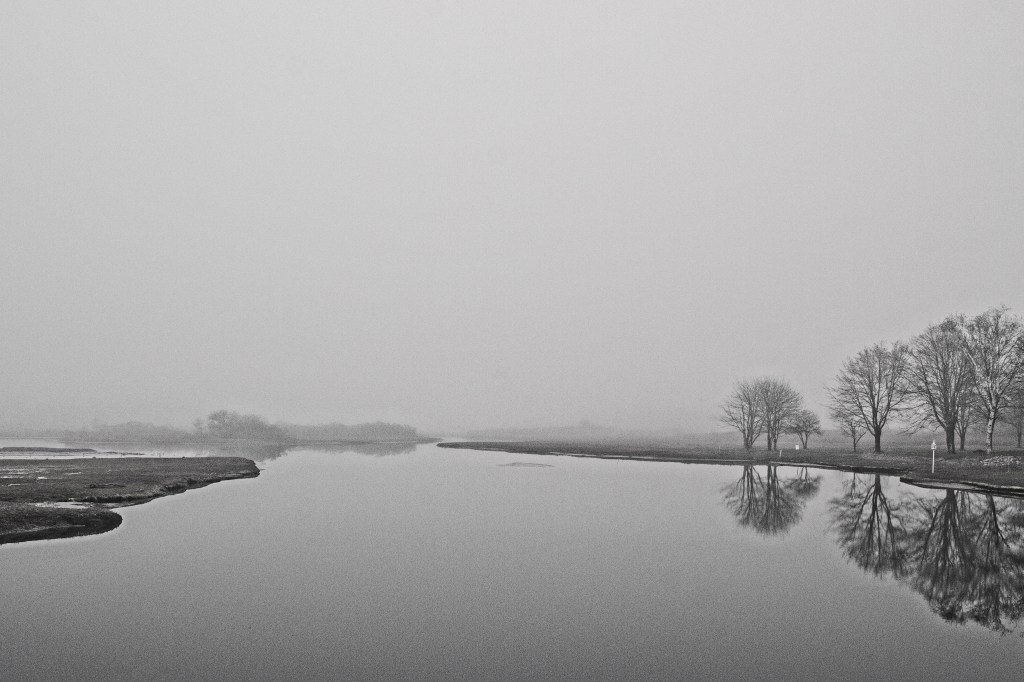
Foggy Morning Drakes Island (John Daly, Photographer)
First, my background. In my present life, I am an Eastern Orthodox Christian with a strong penchant for Russian literature. But my first life was as a fourth-generation Irish kid in a very ethnic neighborhood.
One side of the hill (ours) was the domain of Dalys, Flemings, Gearys, O’Reilys, and a host of other good Irish families, which back in the day meant you were a mass-going Roman Catholic whose father and grandfather may or may not have donated a twenty to Noraid under pressure from the ushers at the eight o’clock mass.
The other side of the hill was the domain of Noars, Cohens, Steins, Roths, Wieners, and a host of other good Jewish names. The Jewish families were mostly Orthodox, with a few Reform thrown in. Some of the Orthodox Jews drove to the other side of town on Friday afternoons to stay with relatives closer to the synagogue, and quite a few of the rest walked the mile and a half down the hill on Saturday mornings (and up again later) to go to Sabbath services at Shari Torah.
Needless to say, we lived side by side in entirely different, but somehow strikingly similar worlds. We were profoundly aware of who we were and where we came from. I remember the shock and sadness I felt when I first learned that so many of my Jewish friends had no grandparents, no aunts or uncles, no cousins — they were all murdered in the Holocaust. They were astonished that so many of us had close family alive back in Ireland. And, though all of us kids spoke English without an accent — if one considers an Eastern Massachusetts accent unaccented — we had very different ways of speaking it. The Jewish kids had lots of Yiddish terms, and we Irish had a lot of turns of phrase that none of our WASPy friends could make sense of. It was like having code languages all our own, something that distinguished us from others. And we were proud of it.
Which leads me to how Clair Keegan’s short stories in her 2007 book, Walk the Blue Fields, brought me home to the lost world I grew up in sixty years ago. Keegan is an Irish writer, meaning she’s native to the country and writes about the country she grew up in without the gush and treacle of Irish-American fantasies. The Ireland she reveals is as far from the Auld Sod we imagined as the world we grew up in on that Worcester hill was from the Wild West of European imagination.
There is one thing, though, that Keegan does have in common with my childhood, and that is language. The English she writes is the dialect of my childhood. No, not the accent, but the way it plays on my heart. The people are people I remember. The community values, the loves and hates, our constant awareness of our neighbors and where we stood in the pecking order, from well-regarded (and secretly hated) to reprehensible (and not so secretly pitied). Even the smells which the author describes so richly are the ones I recall as the smells of home.
Claire Keegan brought me back to that first life, the one I expect I shall recall in my years of decline ever more clearly as my more recent incarnations dissolve in the bewilderment of old age.
The first of the stories in the collection was uncomfortable reading, so much so that I wondered if I’d read any more. Yet, I couldn’t help myself from continuing. It was the language that snagged me, the way the words thrummed and caused my own heart to thrum along with them.
I’m still partial to Russian literature. I’m still moved by the great works of my own country. But Keegan reminded me of my first tongue, an English peculiar to a certain People, with a particular memory that I was blessed to be born into, the language of my heart.
Is it OK to Fall in Love with Reprehensible Characters?
Image created by John Daly using ChatGPT5 imaging tool
So, what does a villain mean to you? Psychopaths (think Hannibal Lecter and Jame “Buffalo Bill” Gumb in The Silence of the Lambs)? Sociopaths (think Todd Alquist in Breaking Bad, or Amy Dunne in Gone Girl, or Dexter)? Something else?
I’ve been presenting my new novel, THE WHISPER OF FALLING SNOW (to be published this winter), to two different critique groups over the past couple of years. One of the most surprising things I hear back in my critiques is how, despite trying to resist doing so, my readers have come to care for and even love two of my chief villains.
They are much chastened in the afterlife—who isn’t?—but in the novel, they are truly bad guys. Stepanov is directly responsible for the deaths of thousands of innocent lives—they may haunt him toward the end of his life, but his actions remain utterly reprehensible. Dane’s god is the State for which he acts as an assassin, killing Stepanov’s (truly psycho-sociopathic father) and tormenting others to the point of insanity.
So how could anyone come to care for these guys? How could I, their creator, come to care for them? What internal trickery of the mind did these characters work in my mind to make it so?
The truth is, I feel extreme ambiguity about normalizing characters who have done outright evil, not once, but as a way of life. It feels slimy, creepy, deeply scary. Like taking a couple of monsters from Auschwitz and making them people you can relate to.
In all fairness, they are not quite like the horrific individuals who made the selections when trains loaded with Jewish men, women, and children were shipped from the ghettos to Auschwitz for annihilation in the chambers. Stepanov merely signed the death warrants, and Dane’s atrocities were mostly committed on an individual basis. AS IF THAT REALLY MAKES A DIFFERENCE!
Yeah, I’ve got some true sociopaths in my novel. Persistence Greenforest plays the role magnificently, and Pavel Stepanov (Grigori’s father) straddles the line between psychopath and sociopath. Lamia Nightshade and Adamant Darling are actual concentration camp nightmares. No one (thank God) relates to or cares about them. But these are minor characters in the novel. Grisha Stepanov and Jeff Dane play huge roles.
Maybe I let them talk too much, or relate too much, or grow too much. I don’t know. But what do YOU do with the villains you come to care about in your writing, or in the books you read? I’d love to hear from you.
I’m sharing this from my Substack ruminations for the day.
I’ve been thinking a lot about worldbuilding and scene-setting lately, in other people’s works, but especially in my own. Because I write literary speculative fiction, I tend to think of worldbuilding in terms of the underlying philosophical, metaphysical, and moral questions it raises. How can I do this without coming across as preachy? I hate being bludgeoned by an author’s loudly stated and embarrassingly obvious points of view—especially when they aren’t my own. Actually, I hate it just as much when someone uses a megaphone to blast out points of view that are my own.
So how do I present differing and meaningful world views of the true, the good, and the beautiful—or the false, the cruel, and the ugly—without insulting the reader? The most obvious answer is to let my characters speak and act for themselves, and to almost always have some doubt about where they stand. The less dogmatic and the more doubtful, the better.
Basically, just let the good guys and the bad guys and everyone else in between be like real people. The greatest compliment I get from my readers is that they come to care about my villains even though some of them do truly awful things. It shows me that I’ve accomplished something important. I’ve made them into three-dimensional human beings. Likewise, I’m pleased when someone says that some of the good guys are sometimes a bit uncomfortable to be around.
I was asked recently what my greatest fear about publishing is, and my response was, “Pissing everyone off.” But, as I thought more about it, I came to the conclusion that it was OK to tick my readers off, so long as it wasn’t everyone all the time. The books that have had the most impact on my life, on some level, annoyed me, made me uncomfortable, and forced me to look at the great questions of good and evil in radically new ways. I was grateful for that, not because I was converted, but because I was given the chance to look at the universe from a new perspective and through a different set of eyes.