How Claire Keegan’s Writing Brought Me Home
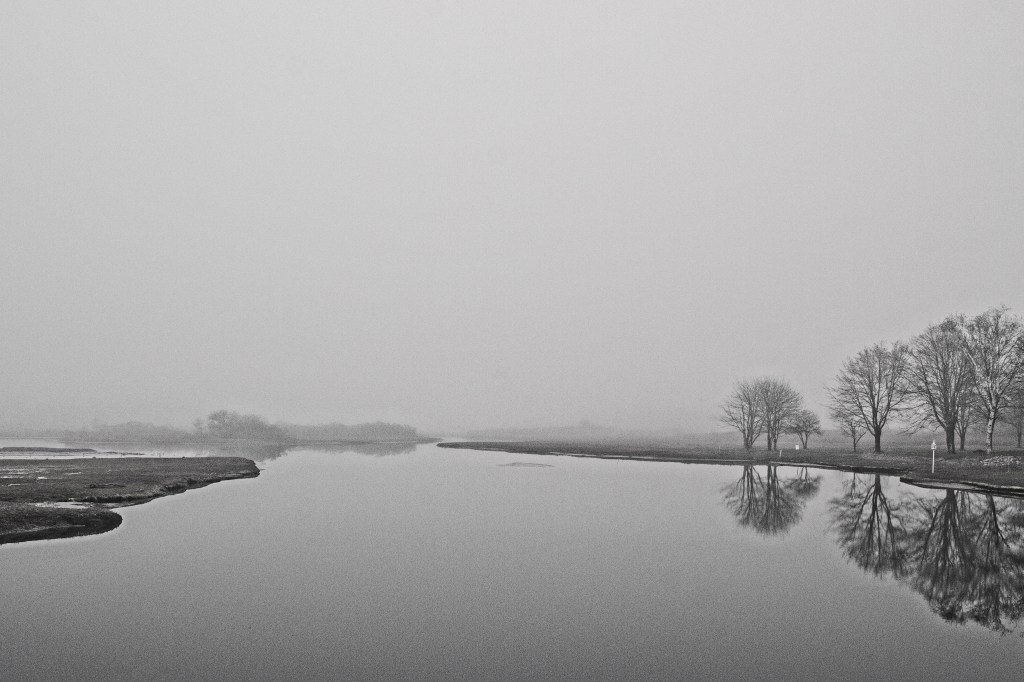
Foggy Morning Drakes Island (John Daly, Photographer)
First, my background. In my present life, I am an Eastern Orthodox Christian with a strong penchant for Russian literature. But my first life was as a fourth-generation Irish kid in a very ethnic neighborhood.
One side of the hill (ours) was the domain of Dalys, Flemings, Gearys, O’Reilys, and a host of other good Irish families, which back in the day meant you were a mass-going Roman Catholic whose father and grandfather may or may not have donated a twenty to Noraid under pressure from the ushers at the eight o’clock mass.
The other side of the hill was the domain of Noars, Cohens, Steins, Roths, Wieners, and a host of other good Jewish names. The Jewish families were mostly Orthodox, with a few Reform thrown in. Some of the Orthodox Jews drove to the other side of town on Friday afternoons to stay with relatives closer to the synagogue, and quite a few of the rest walked the mile and a half down the hill on Saturday mornings (and up again later) to go to Sabbath services at Shari Torah.
Needless to say, we lived side by side in entirely different, but somehow strikingly similar worlds. We were profoundly aware of who we were and where we came from. I remember the shock and sadness I felt when I first learned that so many of my Jewish friends had no grandparents, no aunts or uncles, no cousins — they were all murdered in the Holocaust. They were astonished that so many of us had close family alive back in Ireland. And, though all of us kids spoke English without an accent — if one considers an Eastern Massachusetts accent unaccented — we had very different ways of speaking it. The Jewish kids had lots of Yiddish terms, and we Irish had a lot of turns of phrase that none of our WASPy friends could make sense of. It was like having code languages all our own, something that distinguished us from others. And we were proud of it.
Which leads me to how Clair Keegan’s short stories in her 2007 book, Walk the Blue Fields, brought me home to the lost world I grew up in sixty years ago. Keegan is an Irish writer, meaning she’s native to the country and writes about the country she grew up in without the gush and treacle of Irish-American fantasies. The Ireland she reveals is as far from the Auld Sod we imagined as the world we grew up in on that Worcester hill was from the Wild West of European imagination.
There is one thing, though, that Keegan does have in common with my childhood, and that is language. The English she writes is the dialect of my childhood. No, not the accent, but the way it plays on my heart. The people are people I remember. The community values, the loves and hates, our constant awareness of our neighbors and where we stood in the pecking order, from well-regarded (and secretly hated) to reprehensible (and not so secretly pitied). Even the smells which the author describes so richly are the ones I recall as the smells of home.
Claire Keegan brought me back to that first life, the one I expect I shall recall in my years of decline ever more clearly as my more recent incarnations dissolve in the bewilderment of old age.
The first of the stories in the collection was uncomfortable reading, so much so that I wondered if I’d read any more. Yet, I couldn’t help myself from continuing. It was the language that snagged me, the way the words thrummed and caused my own heart to thrum along with them.
I’m still partial to Russian literature. I’m still moved by the great works of my own country. But Keegan reminded me of my first tongue, an English peculiar to a certain People, with a particular memory that I was blessed to be born into, the language of my heart.

